Basement Waterproofing Cost: Interior Drainage, Exterior Excavation, and What to Check First
Published: June 24, 2026Updated: June 28, 2026Read Time: 8 min readBy Mauricio L.
Share:
Link Copied!Ready to share.
Avg. Interior System$3,500-$10,000
Interior Drainage / LF$40-$85
Exterior Excavation / LF$100-$250
Sump Pump Installed$600-$1,500
Highlights
[ NOTE // 01 ]
Basement waterproofing averages $3,500–$10,000 for a complete interior drainage system. Interior perimeter drain systems run $40–$85/LF ($4,000–$8,000 total). Exterior excavation and membrane waterproofing runs $100–$250/LF ($10,000–$25,000 total). Before investing in either, confirm that surface drainage, downspout extensions, grading, and gutters, is correctly routing water away from the foundation. Surface drainage problems cause the majority of basement moisture issues and are the lowest-cost fix.
Basement water problems have two sources with different solutions: surface water from rain that pools near the foundation, and groundwater from a seasonally high water table. The correct diagnosis determines whether the fix costs $50 or $15,000.
Surface water infiltration, water that enters after heavy rain, primarily through the cove joint (the seam where the floor meets the wall) or through porous concrete, is usually caused or worsened by inadequate drainage at the house perimeter. Groundwater infiltration, which appears regardless of recent rainfall and is more constant, reflects a water table problem that requires a drainage and pump system to manage.
Summary
Check surface drainage first. If downspouts discharge near the foundation, extending them 5–10 feet costs $50–$150 and may resolve the problem without professional waterproofing. If drainage corrections don't help, an interior perimeter drain system runs $4,000–$8,000 for most basements. Exterior excavation, digging down to the footing and applying a waterproof membrane, runs $10,000–$25,000 and is appropriate for structural cracks or cases where interior systems have failed.
Cost ranges from Meazora 2026 installer data. Technical standards per InterNACHI and FRA guidelines.
What this article covers:
How water enters a basement: the cove joint and the clay bowl effect
Surface drainage: what to check before calling a waterproofing contractor
Interior drainage systems: how they work and what they cost
Exterior waterproofing: when it's necessary and why it costs more
How Water Enters a Basement: The Cove Joint
The cove joint is the seam where the basement floor slab meets the foundation wall. It's a structural cold joint: the wall was poured after the footing and floor cured, creating a natural gap that's never fully bonded. When hydrostatic pressure builds up in the soil around the foundation (from saturated ground after heavy rain, or from a seasonally high water table), water finds this joint and pushes through it.
Concrete is not waterproof: it's porous at the microscopic level. Water also enters through wall cracks, through porous block or poured concrete walls under sustained hydrostatic pressure, and in older homes through gaps around utility penetrations. The cove joint is typically the highest-volume entry point because it runs the full perimeter.
The Clay Bowl Effect: Why the Backfill Around Your Foundation Matters
During construction, contractors excavate a large area around where the foundation will be poured. After the foundation is complete, the remaining space is backfilled with the excavated soil. This backfilled soil is significantly looser and more porous than the undisturbed soil surrounding it: it hasn't had decades of compaction. In heavy rain, water moves through the path of least resistance, and the loose backfill zone drains toward the foundation wall rather than away from it.
This is why downspout placement matters. A downspout that discharges water 12 inches from the foundation is adding roof runoff directly into the clay bowl. Keeping your gutters clean and extending downspouts 5–10 feet from the foundation, or installing underground piping that carries water past the backfill zone, directly reduces the hydraulic load on the foundation wall.
Interior Drainage Systems: How They Work
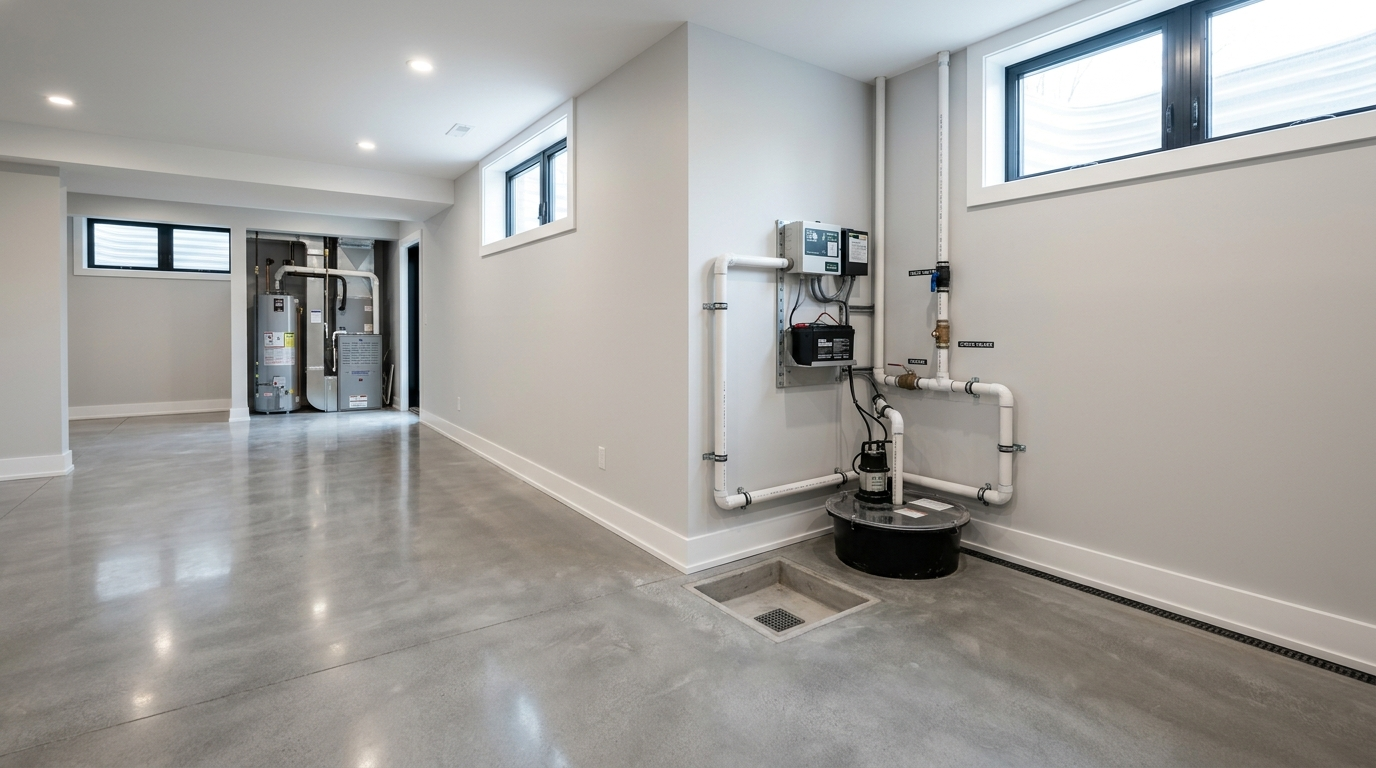
An interior perimeter drain system doesn't prevent water from entering the foundation: it intercepts water at the base of the wall and routes it to a sump pump before it reaches the floor surface.
Installation involves jackhammering the perimeter of the basement floor to expose the footing, excavating a narrow trench, and laying a perforated drain pipe wrapped in filter fabric. A dimpled plastic wall board (drainage mat) is attached to the lower portion of the foundation wall to channel any wall seepage down into the trench. The pipe directs collected water to a sump pit, where a submersible pump ejects it outside the house.
Cost runs $40–$85 per linear foot of perimeter drain, totaling $4,000–$8,000 for a typical basement. The concrete floor is patched over the trench (which can be budgeted using our concrete calculator) after installation. Reputable contractors typically include a 5–10 year warranty on the drainage system.
Sump Pump: Required with Any Interior Drainage System
The drainage system collects water; the sump pump removes it. A submersible pump in a sump pit activates automatically when water level rises above a float switch. Installation cost runs $600–$1,500 including the pump, pit excavation, and dedicated electrical circuit.
Battery backup units are worth considering in areas with frequent storm outages, pump failure during a heavy rain event negates the entire drainage system. A battery backup system adds $300–$500 and provides 8–12 hours of pump operation without grid power. Some homeowners also install a secondary backup pump alongside the primary.
Exterior Waterproofing: What It Involves and When It's Warranted
Exterior waterproofing requires excavating down to the foundation footing around the full perimeter of the house. A waterproof membrane is applied to the exterior wall surface, and a drainage board and exterior drain pipe are installed before backfilling.
This approach addresses the source of water entry directly, at the outside of the wall, rather than managing it after it enters. It's appropriate when interior drainage has failed, when active structural cracks allow water entry above the footing level, or when the foundation wall itself needs inspection or repair.
Cost runs $100–$250 per linear foot, totaling $10,000–$25,000 for a full perimeter. Heavy equipment, extensive labor, landscape restoration, and potential interference with underground utilities make this a significantly more complex project than interior drainage.
To estimate project scope and cost for your basement's perimeter, work with a licensed waterproofing contractor who provides a written assessment of the water entry mechanism before proposing a solution. Use our remodeling calculators to estimate baseline costs for your basement square footage.
Frequently Asked Questions
Can I waterproof my basement from the inside, or do I need exterior work?▼
Most basement water infiltration can be managed from the interior. An interior perimeter drainage system and sump pump doesn't prevent water from entering the foundation walls: it intercepts it at the base of the wall and routes it to the pump before it reaches the floor. Exterior excavation and membrane waterproofing addresses the source directly (outside the wall) and is appropriate for active structural cracks that allow water in above the footing. It's significantly more expensive and invasive. If your inspector confirms the water entry is at the cove joint (floor-wall seam) without structural cracking, interior drainage is the standard approach.
Will extending my downspouts reduce basement water infiltration?▼
For surface-water problems, water that pools near the foundation after rain and migrates through the wall or cove joint, yes, improving surface drainage is the correct first step. Downspout extensions that carry water 5–10 feet from the foundation, combined with grading that slopes away from the house at 6 inches over the first 10 feet (per IRC grading requirements), can significantly reduce water pressure against the foundation wall. If infiltration persists after surface drainage is corrected, the source is likely groundwater or a high water table, which requires a sump and drainage system.
§
Research Citations & Verified Authorities
EEAT Compliant
To maintain absolute calculation integrity and trust, the structural lifespans, standard sizes, and pricing models in this guide are gathered from governing construction authorities and verified trade standards.
International Association of Certified Home Inspectors (InterNACHI) - Basement and Crawlspace Inspection GuideAudit Source →
Foundation Repair Association (FRA) - Technical StandardsAudit Source →
Mauricio L.
// Creator of Meazora
Mauricio L. is a software developer who loves working with his hands. He built Meazora because he was tired of online calculators that exist just to capture your email and phone number. Every calculator here runs completely in your browser to keep your planning private, fast, and simple.