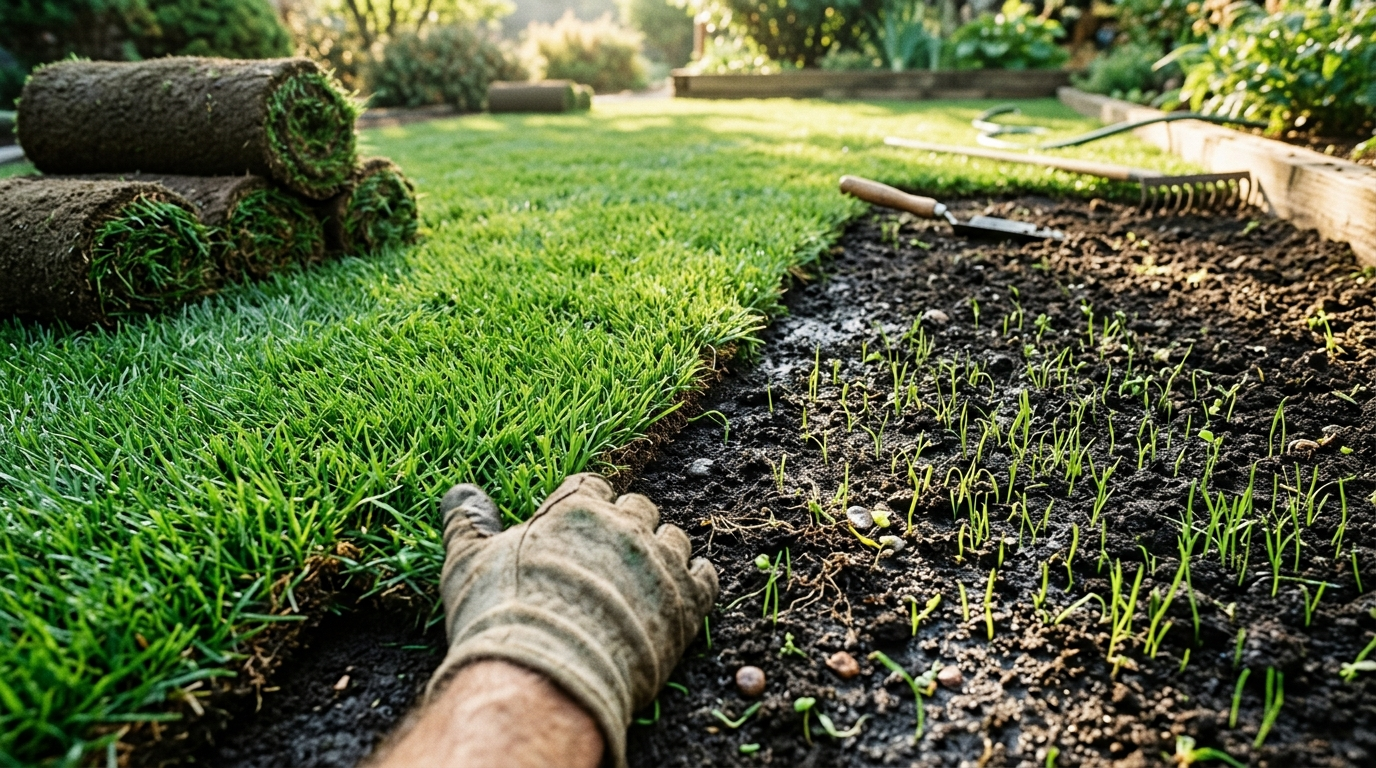
Sod and seed are the same product at different stages of development. Sod is grass that has been grown for 12–18 months on a farm, harvested with its root mat intact, and delivered as rolls or slabs ready to lay. Seed starts that same process from the beginning in your soil. The price difference, roughly 10x more for sod than for comparable seed coverage, reflects what you're paying for: the farm's time and resources to grow the grass to maturity.
The decision between them is primarily about timeline vs. cost. Sod is a usable lawn in 2 weeks. Seeded grass is a fragile, vulnerable surface for 6–12 weeks and doesn't reach full density for a full growing season. Most situations have a clearly better answer.
What this article covers:
- Full cost breakdown: sod installation, seeding, and hydroseeding
- Timeline comparison with establishment milestones
- Which grass species are only available as sod
- Risk factors and common seeding failures
Cost Breakdown: Sod vs Seed
Here's what each option costs for a typical 5,000 sq ft lawn:
- Seed: $0.10-$0.40/sq ft ($500-$2,000 for 5,000 sq ft)
- Soil prep: $300-$800 (tilling, grading, starter fertilizer)
- Straw or erosion matting: $200-$500 (optional, prevents washout)
- Total DIY: $1,000-$3,300
- Total professional (hydroseeding): $2,500-$5,000
Sod is undeniably expensive. But consider this: sod arrives as mature grass with an established root system. Seed starts from zero. You're paying for 12-18 months of growth that happened on a sod farm, growth you don't have to wait for.
Timeline Comparison
This is where the decision often gets made:
- Day 1: Prepare soil and plant seed (4-6 hours)
- Days 1-14: Water 2-3x daily, keep soil constantly moist
- Day 7-21: Germination (varies by grass type)
- Week 4-6: First mow (when grass is 3-4 inches tall)
- Week 8-12: Lawn looks established but thin
- Month 6-12: Full maturity and thickness
Success Rate and Risk Factors
Sod success rate: 90-95% if installed correctly and watered properly. Failure is usually due to underwatering, poor soil contact, or installing in extreme heat.
Seed success rate: 60-80% for first-time growers. Common failures include:
- Birds and animals: Finches, sparrows, and squirrels eat grass seed. Netting or straw covering helps.
- Washout: Heavy rain can wash seed into gutters or low spots. Erosion matting prevents this.
- Drying out: Seed dies if soil dries for even a few hours during germination. Daily watering is non-negotiable.
- Weeds: Weed seeds germinate faster than grass. Pre-emergent herbicides can't be used on new seed, so weeds often take over.
Sod arrives weed-free and mature enough to outcompete weeds. Seed requires vigilant weed control for the first 3-4 months. When planning landscape borders, you can calculate coverage using our mulch and gravel calculator, or budget a protective boundary with our fence calculator.
Grass Type Matters
Not all grasses are available as both sod and seed:
- Kentucky Bluegrass: Available as sod and seed. Cold-hardy, self-repairing. Best for northern climates.
- Fescue (Tall and Fine): Available as sod and seed. Drought-tolerant, shade-tolerant. Good transition zone grass.
- Bermuda Grass: Mostly sod (some seed available). Heat-loving, aggressive spreader. Best for southern climates.
- St. Augustine: Sod only (doesn't produce viable seed). Excellent for Florida and Gulf Coast.
- Zoysia: Mostly sod. Slow-growing, dense, drought-tolerant. Good for high-traffic lawns.
If you want St. Augustine or certain Zoysia varieties, sod is your only option.
When Sod Makes Sense vs. When Seed Does
Sod is the practical choice when timeline matters: selling the home soon, immediate erosion control on a slope, grass types only available as sod, or an inability to maintain a seeded area during the 6–12 week establishment window. The 10x price premium is essentially the cost of eliminating the wait and the variability of seeded establishment.
Seed makes sense when budget is the constraint and the timeline is flexible. Large areas favor seed more strongly: the per-SF cost difference compounds significantly at 10,000+ SF. Overseeding an existing thin lawn (rather than full lawn installation) almost always makes more sense with broadcast seed or hydroseeding than with sod, which requires removing existing grass first.
The Middle Ground: Hydroseeding
Hydroseeding sprays a slurry of seed, fertilizer, mulch, and binding agents onto prepared soil. It costs $2,500-$5,000 for 5,000 sq ft, more than DIY seed, less than sod. Benefits include:
- Faster germination (5-7 days vs 14-21 for broadcast seeding)
- Better moisture retention (mulch layer holds water)
- Less erosion and washout
- More even coverage than hand-spreading
Hydroseeding is a good compromise if you want better results than DIY seeding without paying sod prices.
Long-Term Costs: Year 2 and Beyond
Once established, sod and seed lawns cost the same to maintain: mowing, fertilizing, watering, and occasional overseeding. The initial cost difference is sunk, after year one, a sod lawn and a seeded lawn look identical and require identical care.
One caveat: sod lawns sometimes struggle in year 2-3 if the underlying soil wasn't prepared properly. Sod grown on sandy farm soil can struggle when laid over clay without amendment. Seeded lawns adapt to your native soil from day one, potentially giving them better long-term resilience.