With rising energy rates across the nation, homeowners are constantly looking for ways to lower their electricity and gas bills. While replacing an old AC or heating system seems like the obvious solution, it is often a waste of capital if your home has hidden air leaks or insulation gaps. A high-efficiency unit will still run continuously if the conditioned air escapes your house immediately.
This is where a home energy audit comes in. An energy audit is a comprehensive diagnostic assessment of your home's thermal envelope. By finding exactly where energy is leaking, an audit creates a customized roadmap for upgrades, ensuring you only spend money on improvements that deliver the highest return on investment (ROI).
What is the Cost of a Home Energy Audit?
On the open market, hiring an independent home energy auditor costs between $250 and $600 for an average 2,000 square foot home. The price increases with the size and age of the house, as older properties require more inspection time to isolate wall cavities and complex crawlspaces.
However, you should never pay full price without checking with your local electric or gas utility company first. Many utilities partner with certified contractors to subsidize home energy assessments.
- Subsidized Audits: Utilities often cover 50% to 80% of the audit cost, charging the homeowner just $50 to $150 out of pocket.
- Free Audits: In some regions, utilities offer visual audits or basic blower-door assessments entirely for free to incentivize energy conservation.
- Direct Rebates: Audit reports often make you eligible for exclusive utility rebate programs covering up to 50% of the cost of subsequent insulation or HVAC upgrades.
Understanding the Home Energy Audit Tax Credit (Section 25C)
The Inflation Reduction Act of 2022 significantly expanded the Section 25C Energy Efficient Home Improvement Credit. Starting in 2023 and running through 2032, homeowners can claim a federal tax credit covering 30% of their home energy audit cost, up to a maximum of $150.
To successfully claim this tax credit on your federal return (using IRS Form 5695), the audit must meet strict compliance standards:
- Certified Professional: The audit must be performed by a qualified home energy auditor holding certified credentials from the Building Performance Institute (BPI) or the Residential Energy Services Network (RESNET).
- Written Report: The auditor must provide a comprehensive written report signed by the certified technician. The report must identify prioritized energy efficiency improvements, estimate the cost of implementation, and estimate the projected monthly utility savings.
- Primary Residence: The credit is only available for audits conducted on your primary residential property in the United States.
What Savings Can You Expect?
A home energy audit itself does not save energy; the savings come from implementing the report's recommendations. The Department of Energy (DOE) estimates that the average homeowner saves 15% to 30% on heating and cooling bills by completing standard air sealing and insulation upgrades recommended during an audit.
For a typical household paying $2,000 annually in heating and cooling costs, a 20% reduction saves $400 every single year.
The diagram below outlines the primary areas where thermal energy leaks from a typical residential structure.
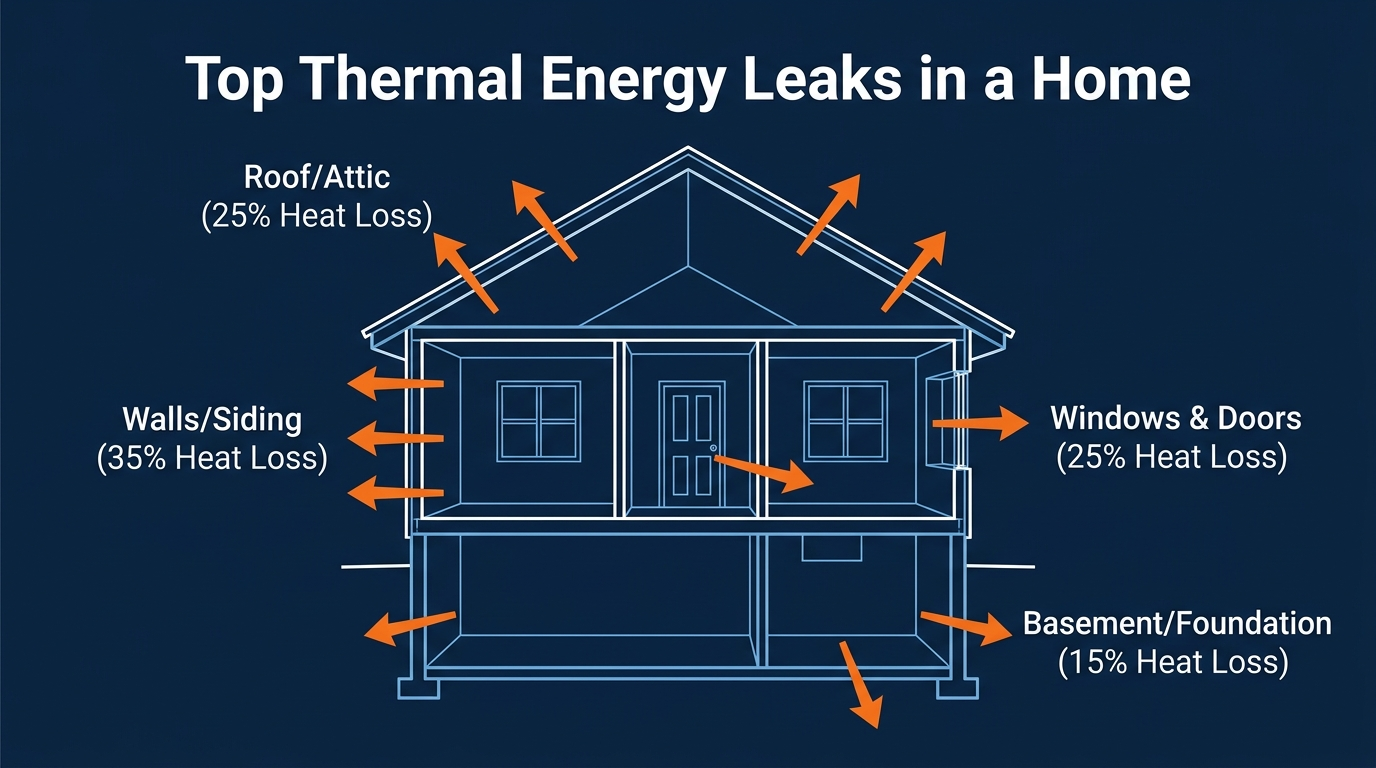
🔌 Share This Diagram on Your Site (Embed Code)
▼
Blower Door Testing & Thermographic Diagnostics
A professional audit is highly scientific. The auditor uses specialized diagnostic equipment to locate leaks that are invisible during a simple visual walkthrough:
Blower Door Test: The auditor seals an exterior door frame with an airtight fabric shroud and mounts a powerful, calibrated fan. The fan sucks air out of the home, depressurizing the interior to -50 Pascals (Pa). This pressure difference simulates a 20-mph wind blowing against the home from all directions simultaneously, forcing outside air through every crack in the building envelope.
The auditor measures the airflow (expressed in CFM50, or Cubic Feet per Minute at 50 Pa) required to hold the pressure constant. This figure is converted into ACH50 (Air Changes per Hour). A modern energy-efficient home built to code should have an ACH50 score of 3.0 or lower. Older homes often test at 10.0 to 15.0 ACH50, indicating massive, uncontrolled air leakage.
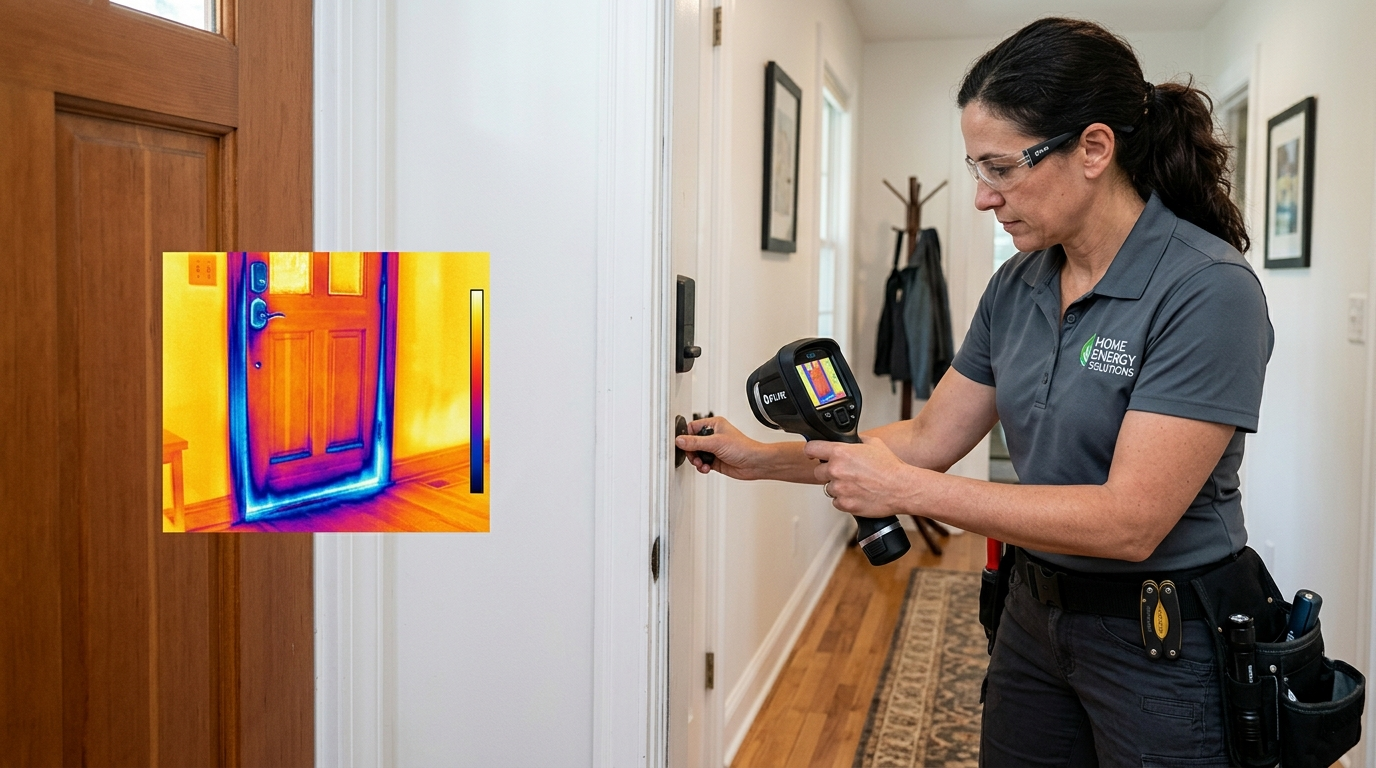
Thermal Imaging: While the home is depressurized, the auditor walks through the rooms with an infrared (thermographic) camera. The negative pressure pulls cold air (in winter) or hot air (in summer) through hidden wall cavities, top plates, and electrical boxes, showing up as bright temperature anomalies on the camera screen. This pinpoints exactly where air sealing is needed.
Is a Home Energy Audit Actually Worth It?
An energy audit is absolutely worth the investment for almost any home built more than 5 years ago. It takes the guesswork out of home improvements. Instead of spending $10,000 on new windows (which have a long payback period of 15 to 20 years), the audit may show that spending $1,500 on air sealing and attic insulation (which has a quick payback of 2 to 4 years) will deliver double the energy savings.
By using local utility subsidies and claiming the 30% federal tax credit on IRS Form 5695, you can reduce the net cost of the audit to under $100, yielding immediate return on investment the very first month your utility bill arrives.