Kitchen Remodel Costs: Budget, Mid-Range, and Luxury Explained
Published: June 23, 2026Updated: July 3, 2026Read Time: 9 min readBy Mauricio L.
Share:
Link Copied!Ready to share.
Budget Remodel$12,000-$25,000
Mid-Range Remodel$25,000-$65,000
Luxury Remodel$65,000+
Avg. ROI at Resale50%-82% (NKBA)
Highlights
[ NOTE // 01 ]
A mid-range kitchen remodel averages $25,000–$65,000 in 2026. Budget cosmetic updates start around $12,000; luxury renovations with structural changes exceed $65,000. Cabinetry is typically the single largest expense, at 30% of the total budget per NKBA guidelines. Keeping plumbing and electrical in their existing locations has more effect on controlling costs than any material choice.
Topic Cluster Hub Guide
This guide is a specialized spoke of our comprehensive Kitchen Remodel Cost & Planning Guide 2026→. Check it out for all calculations, material sizing, and industry standards.
The most reliable way to control a kitchen remodel budget is to not move anything. Keeping the sink, stove, dishwasher, and refrigerator exactly where they are eliminates most of the expensive rough-in work. Moving a sink to create an island requires breaking into the floor or subfloor to reroute drain and supply lines, labor that adds $3,000–$5,000 before any aesthetic work begins.
That single decision, layout change or no layout change, separates a $20,000 budget remodel from a $50,000 one more than cabinetry tier, countertop material, or appliance brand. Everything else in the cost breakdown flows from that choice.
Summary
Budget remodels ($12,000–$25,000) keep the existing layout and cabinet boxes. Mid-range ($25,000–$65,000) includes new semi-custom cabinets, updated appliances, and mid-tier countertops. Luxury ($65,000+) involves structural changes, custom cabinetry, and premium materials. Per NKBA guidelines, cabinetry typically consumes 30% of the total budget regardless of tier. Budget remodels return 75–82% at resale; luxury remodels return 50–60%.
Cost ranges from Meazora 2026 installer data. ROI figures from Remodeling Magazine Cost vs. Value and NKBA guidelines (learn how renovations add resale value or estimate specific gains with our remodeling ROI calculator).
What this article covers:
What separates the three remodel tiers, and why ROI inverts as you spend more
Cabinet refacing: when it makes sense and when it doesn't
Where the money actually goes in a mid-range project
Permit requirements and what skipping them costs you at resale
The Three Tiers: What You Get at Each Level
Budget remodel ($12,000–$25,000): No layout changes. Keeps existing cabinet boxes. Includes cabinet painting or refacing, laminate or entry-level quartz countertops, a new faucet, and cosmetic updates. Timeline: 2–4 weeks. ROI at resale: 75–82% per Remodeling Magazine Cost vs. Value data.
Mid-range remodel ($25,000–$65,000): New semi-custom cabinets, a kitchen island, mid-tier quartz or granite countertops, under-cabinet lighting, and updated stainless steel appliances. May include minor electrical upgrades for additional circuits. Timeline: 6–10 weeks. ROI at resale: 55–65%.
Luxury remodel ($65,000+): Structural changes, often removing walls or relocating plumbing. Custom cabinetry, commercial-grade appliances, premium stone slabs, new flooring. Requires permits for structural and mechanical work. Timeline: 4–6 months. ROI at resale: 50–60%.
The counterintuitive pattern: the more you spend, the lower the percentage you recover at resale. This isn't a flaw in the data: it reflects the ceiling effect. Buyers in a given neighborhood compare your home to others in the same price range. A kitchen renovation that pushes your asking price above comparable homes in your area doesn't produce proportional sale price increases.
Cabinet Refacing: The Math on When It Works
Cabinetry is typically the largest single line item in any kitchen remodel. Before ordering new cabinet boxes, assess whether your existing ones are worth keeping.
Cabinet refacing replaces only the visible surfaces: doors, drawer fronts, and a veneer applied to the exposed face frames. The box structure, the part behind your plates and pans, stays in place. A competent contractor completes refacing in 3–5 days versus 2–3 weeks for full replacement.
Refacing saves 40–50% compared to full replacement and makes sense when the existing box structure is solid plywood or solid wood (not swollen particle board), structurally square, and free of water damage. The test: open a cabinet, pull a drawer out, and look at the raw material at the corners. Press with a finger near any water-exposed area. If the material is firm and the box is square, refacing is viable. If the material is soft, swollen, or crumbling, replacement is the correct path.
Where the Budget Goes: Mid-Range Breakdown
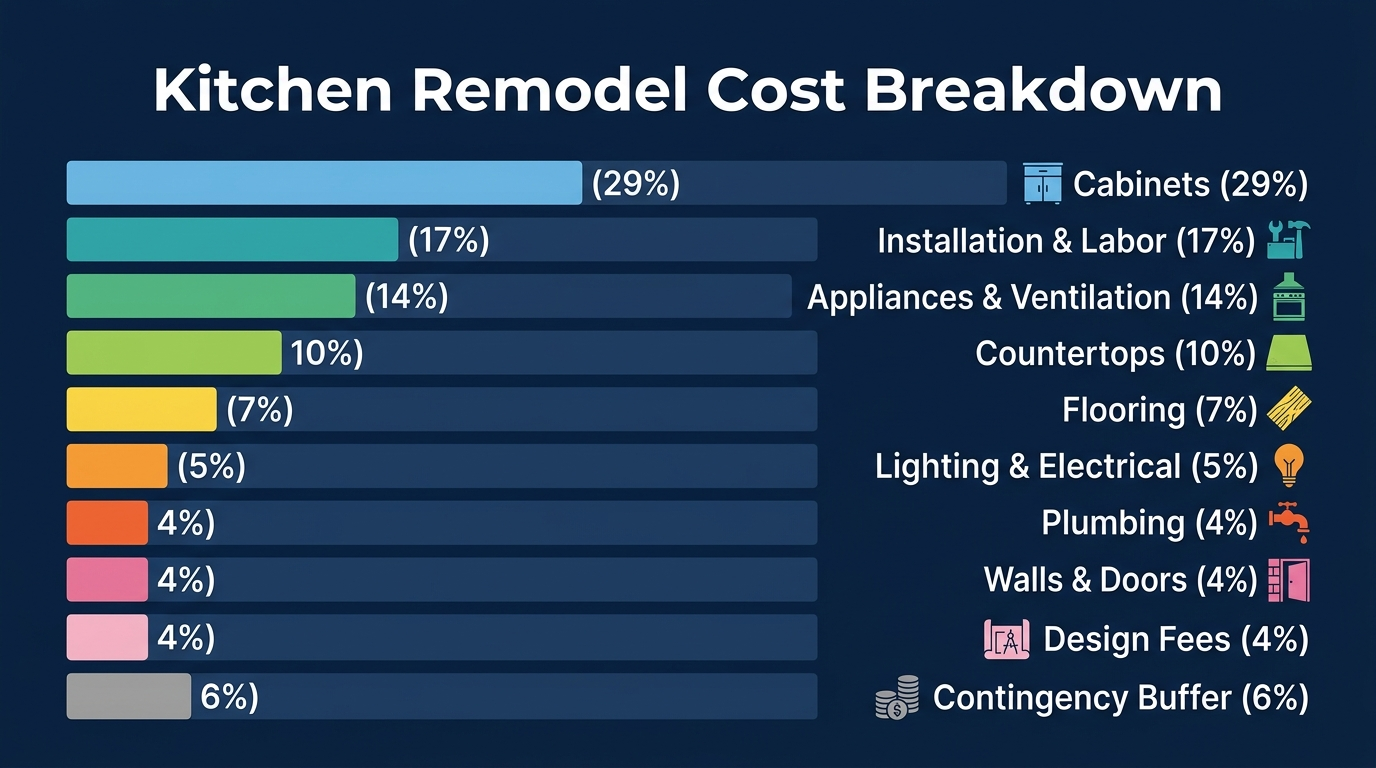
Budget Component
Typical % of Budget
Example at $40k
Cabinetry & Hardware
~30%
~$12,000
Labor & Installation
~20%
~$8,000
Appliances & Ventilation
~15%
~$6,000
Countertops
~10%
~$4,000
Plumbing & Electrical
~10%
~$4,000
Flooring
~7%
~$2,800
Backsplash & Lighting
~5%
~$2,000
Design & Permits
~3%
~$1,200
🔌 Share This Graphic on Your Site (Embed Code)▼
Percentage breakdown per NKBA Kitchen and Bath Cost Guidelines. Example figures illustrative only; actual distribution varies by market and project scope.
Permits: The Cost of Skipping Them at Resale
Permit fees for kitchen remodels typically run $500–$2,500 depending on the municipality and scope. Cosmetic work, painting, countertop replacement, flooring, generally doesn't require permits. Moving electrical circuits, plumbing, or structural walls requires them in virtually all jurisdictions.
Unpermitted work creates a problem at resale. Home inspectors flag it. Buyers request that it be properly permitted before closing, which can require opening walls to expose work that's already been finished, inspected, and approved by a licensed inspector. The cost of retroactive permitting almost always exceeds the original permit fee.
Contractor Selection: Four Things to Confirm Before Signing
Fixed-price or time-and-materials? Fixed-price quotes give you budget certainty; time-and-materials leaves the final number open-ended. Prefer fixed-price with a written scope of work for any project over $10,000.
What's explicitly excluded? Ask the contractor to list what's not included in the quote, permit fees, appliance delivery, demolition haul-away, and structural unknowns are frequent omissions. Get exclusions in writing.
Payment schedule? Standard industry terms are 10% at contract signing, milestone payments at rough-in and installation phases, and a final 10% at walkthrough completion. Requests for more than 30% upfront warrant scrutiny.
Who pulls the permits? The contractor should pull all permits as the licensed contractor of record. If they suggest you pull permits as the homeowner to reduce paperwork, that shifts liability to you, and eliminates their accountability for code compliance.
To get a cost estimate based on your kitchen's dimensions and scope, use our Kitchen Remodel Calculator.
Frequently Asked Questions
What's the most expensive part of a kitchen remodel?▼
Cabinetry typically accounts for roughly 30% of the total budget, followed by labor (around 20%) and appliances (around 15%), per NKBA cost guidelines. If budget is a constraint, cabinet refacing, keeping the existing cabinet boxes and replacing only the doors, drawer fronts, and face frames, can save 40–50% compared to full cabinet replacement without changing how the kitchen looks.
How long does a kitchen remodel take?▼
A minor cosmetic remodel (cabinet painting, new countertops, backsplash) typically runs 2–4 weeks. A mid-range gut renovation with new cabinets and appliances runs 6–10 weeks. A luxury renovation with structural changes, relocated plumbing, or load-bearing wall removal can extend to 4–6 months. Lead times for custom cabinetry, often 6–12 weeks, frequently control the overall timeline.
Should I stay in the house during the remodel?▼
For minor cosmetic work, yes, with some planning. For a gut renovation, the kitchen will be fully out of service for weeks, including running water at the sink. Many homeowners set up a temporary kitchen in a spare room with a mini-fridge, electric skillet, and microwave. For projects over $30,000 that involve structural work, consider whether temporary relocation makes more sense for your situation.
§
Research Citations & Verified Authorities
EEAT Compliant
To maintain absolute calculation integrity and trust, the structural lifespans, standard sizes, and pricing models in this guide are gathered from governing construction authorities and verified trade standards.
National Kitchen and Bath Association (NKBA) - Kitchen Design and Cost GuidelinesAudit Source →
Remodeling Magazine - Cost vs. Value Annual SurveyAudit Source →
Mauricio L.
// Creator of Meazora
Mauricio L. is a software developer who loves working with his hands. He built Meazora because he was tired of online calculators that exist just to capture your email and phone number. Every calculator here runs completely in your browser to keep your planning private, fast, and simple.