Bathroom Remodel Costs: What Changes the Price and What Doesn't
Published: June 21, 2026Updated: June 30, 2026Read Time: 9 min readBy Mauricio L.
Share:
Link Copied!Ready to share.
Half Bath (Powder Room)$5,000-$12,000
Full Bath (Mid-Range)$12,000-$28,000
Master Suite (Luxury)$28,000-$60,000
Avg. ROI at Resale60%-65%
Highlights
[ NOTE // 01 ]
A standard full bathroom remodel averages $12,000–$28,000 in 2026. Half baths run $5,000–$12,000. Master suite renovations with custom tile and premium fixtures range from $28,000–$60,000. Moving a toilet, sink, or shower drain requires opening floors and walls to reroute drain lines, work that adds $1,500–$5,000 per fixture before any aesthetic choices are made.
Topic Cluster Hub Guide
This guide is a specialized spoke of our comprehensive Bathroom Renovation Complete Guide 2026→. Check it out for all calculations, material sizing, and industry standards.
In a bathroom remodel, labor and plumbing fixtures together typically consume about half the budget before a single tile goes on the wall. The other half covers everything the homeowner usually spends the most time choosing: the vanity, the tile pattern, the fixtures, the shower enclosure. Both halves matter, but only one of them significantly changes based on layout decisions.
The decision to move or not move a drain line, toilet, or shower location is the primary variable that separates a $12,000 remodel from a $30,000 one in the same size bathroom. Everything else, tile grade, vanity style, fixture brand, adjusts cost at the margins.
Summary
Half baths run $5,000–$12,000. Full bathrooms average $12,000–$28,000. Master suite renovations with premium finishes run $28,000–$60,000. Moving any drain connection in any tier adds $1,500–$5,000 per fixture before aesthetic choices are factored in. Waterproofing the shower assembly is not optional: it's the work that determines whether the renovation lasts 20 years or 5.
Cost ranges from Meazora 2026 installer data. ROI per NKBA and Remodeling Magazine Cost vs. Value (see our guide on how renovations add resale value).
What this article covers:
What each remodel tier actually includes, by fixture and scope
Why plumbing relocation is the most expensive line item before you pick anything
Waterproofing standards that determine long-term performance
Ventilation requirements and why they matter for the finished surfaces
Cost by Bathroom Type: What Each Tier Includes
Half bath / powder room ($5,000–$12,000): No shower or tub, just a toilet and vanity. Updates stay in place: new vanity cabinet and stone top, toilet replacement, updated faucet and lighting. No plumbing relocation. Timeline: 3–5 days for the visible work.
Standard full bath ($12,000–$28,000): Includes a tub/shower replacement in the same location. Typically: a prefabricated acrylic alcove unit or a custom-tiled shower in the existing footprint, new ceramic or porcelain floor tile, double vanity with stone countertop, updated lighting and fan. Timeline: 2–3 weeks.
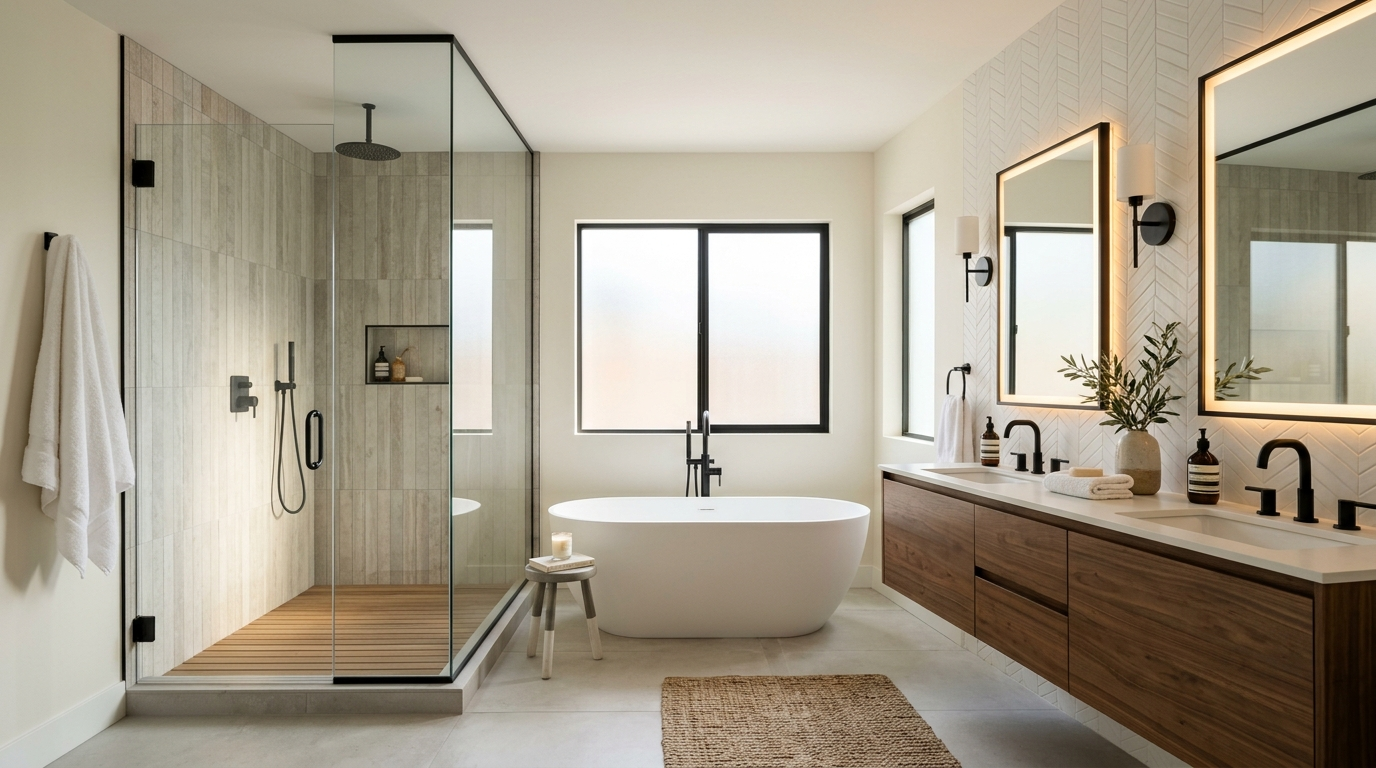
Primary suite ($28,000–$60,000): Custom tile shower with zero-threshold entry, frameless glass enclosure, dual showerheads, freestanding soaking tub, heated tile floor, custom cabinetry, premium plumbing fixtures. Upgrading high-demand fixtures may require checking your water heater lifespan to ensure adequate hot water capacity. Timeline: 6–8 weeks.
Estimate Your Bathroom Remodel Cost
Use our free Bathroom Remodel Calculator to estimate tile, fixture, plumbing, and labor costs based on your bathroom's dimensions and scope.
Percentage estimates per NKBA bathroom cost guidelines. Example figures illustrative for a $15,000 project; actual distribution varies by scope and market.
The waterproofing line item is often the one that separates a remodel that lasts 15–20 years from one that fails in 5. At roughly 8% of a $15,000 project, it's a relatively small portion of the budget for work that determines the longevity of everything installed above it.
Waterproofing: The Work Behind the Tile
Tile and grout are not waterproof. Water passes through grout joints, and if there is no membrane between the grout and the substrate, moisture reaches the wall framing. Over years, that moisture causes rot, mold, and structural damage that costs far more to remediate than a properly installed waterproofing system costs upfront.
The TCNA Handbook, the industry standard for tile installation, specifies approved waterproofing systems for wet areas. Liquid-applied membranes (such as RedGard or equivalent) require a minimum of two coats with fiberglass mesh embedded at all corners and changes of plane. Sheet membrane systems (like WEDI or Schluter Kerdi) are applied to the substrate before tile and provide continuous coverage without the cure time of liquid systems.
Ask your contractor specifically which waterproofing system they're using and whether it meets TCNA standards. This is not a detail to leave unspecified.
Ventilation: Required, Not Optional
A bathroom exhaust fan is required by the International Residential Code in all bathrooms without a window. Even in bathrooms with windows, a properly sized fan is necessary to control humidity after showering and prevent condensation from damaging painted surfaces and grout.
The IRC requires a minimum of 50 CFM for bathrooms under 100 square feet, or 1 CFM per square foot for larger spaces. The fan must exhaust to the exterior, not into the attic or a soffit. Venting into unconditioned attic space deposits moisture where it breeds mold in the insulation and sheathing.
If your existing fan vents into the attic, rerouting the duct to exterior is typically a straightforward addition to a bathroom remodel. Confirm this is part of your contractor's scope if you're doing a full renovation.
Use our Bathroom Remodel Calculator to estimate costs based on your bathroom's square footage and the scope of changes you're planning.
Frequently Asked Questions
How much does it cost to move a toilet even a few inches?▼
Moving a toilet typically runs $1,500–$3,000 in plumbing labor alone. The drain line must be rerouted through the floor structure, which may require notching or sistering structural floor joists, and the vent stack extension must also be modified. In slab-on-grade construction (common in southern states), moving a toilet drain requires saw-cutting and breaking up the concrete slab, which adds significantly to the cost.
Can I use the existing tub drain when converting to a walk-in shower?▼
No. Building codes require a 2-inch minimum drain line for walk-in showers to handle water volume adequately. Standard bathtub drains use a 1.5-inch line. Upsizing requires accessing the drain line below the subfloor and running new pipe back to the main stack, typically adding $800–$1,500 in plumbing labor. This is in addition to the waterproofing system the shower floor and walls require.
What's the most expensive plumbing change in a bathroom remodel?▼
Relocating the main soil stack: the large vertical pipe that vents and drains everything to the sewer or septic. Moving it requires cutting through multiple floor assemblies and the roof structure. This type of work adds $4,000–$8,000 in specialized plumbing labor and is typically only necessary in major layout reconfigurations. Most bathroom remodels avoid touching the stack entirely by working around its location.
§
Research Citations & Verified Authorities
EEAT Compliant
To maintain absolute calculation integrity and trust, the structural lifespans, standard sizes, and pricing models in this guide are gathered from governing construction authorities and verified trade standards.
National Kitchen and Bath Association (NKBA) - Bathroom Design and Cost StandardsAudit Source →
Tile Council of North America (TCNA) - Handbook for Ceramic, Glass, and Stone Tile InstallationAudit Source →
Mauricio L.
// Creator of Meazora
Mauricio L. is a software developer who loves working with his hands. He built Meazora because he was tired of online calculators that exist just to capture your email and phone number. Every calculator here runs completely in your browser to keep your planning private, fast, and simple.