Window Replacement Cost: What Drives the Price Difference Between Windows
Published: June 21, 2026Updated: July 2, 2026Read Time: 7 min readBy Mauricio L.
Share:
Link Copied!Ready to share.
Avg. Window Installed$650-$1300
Vinyl Frame Range$450-$900
Wood / Fiberglass Range$900-$1800
Project ROI at Resale60%-65%
Highlights
[ NOTE // 01 ]
Window replacement costs $650–$1300 per window installed on average. Vinyl frames ($450–$900) are the most common and lowest-maintenance option. Wood or fiberglass frames ($900–$1800) cost more but last significantly longer. Installation method, pocket insert vs. full-frame, has as much effect on total cost as frame material.
Window replacement quotes can range from $600 to $2,000 for what looks like the same window on paper. The price spread isn't arbitrary: it reflects real differences in frame material, installation method, and glass specifications. Understanding those three variables tells you what you're actually comparing across bids.
Summary
Average installed cost is $650–$1300 per window. Vinyl frames ($450–$900) are the standard choice, no maintenance, 15–20 year lifespan. Wood and fiberglass frames ($900–$1800) last 30–50 years. Pocket inserts cost 30–50% less in labor than full-frame, but only work on frames that are structurally sound. All replacement windows should have Low-E glass and argon fill as baseline specifications.
Cost ranges from Meazora 2026 installer data. Lifespan estimates per AAMA performance standards.
What this article covers:
How frame material affects both upfront cost and long-term maintenance
Pocket insert vs. full-frame: which installation method applies to your situation
Glass specifications that matter, and where paying more is worth it
The EPA lead paint rule and what it adds to pre-1978 homes
Frame Materials: Cost vs. Service Life
Frame Material
Cost / Window Installed
Service Life
Maintenance
Standard Vinyl
$450 - $900
15-20 Years
None (Occasional washing)
Fiberglass
$900 - $1,500
30-45 Years
Low (Paintable)
Aluminum-Clad Wood
$800 - $1,400
25-35 Years
Low-Moderate
Natural Wood
$1,000 - $1,800
30-50 Years
High (Paint/seal regularly)
Cost ranges from Meazora 2026 installer data. Lifespan estimates per AAMA window performance standards.
Vinyl's dominance in residential replacement windows comes down to cost and maintenance: it requires neither paint nor sealant over its service life. The limitation is lifespan: at 15–20 years, vinyl will need replacement sooner than fiberglass or wood. For a homeowner planning to sell within 10 years (to see how this choice affects home value, read our guide on how renovations add resale value), vinyl is the practical choice. For a long-term owner, fiberglass's 30–45 year lifespan and dimensional stability (it doesn't expand and contract with temperature the way vinyl does) often justify the higher upfront cost.
Natural wood frames remain an option for historic homes where maintaining original appearance is a priority or a condition of historic preservation requirements. The ongoing maintenance commitment, painting or sealing every 3–5 years, is significant and factored into that decision.
Estimate Your Window Replacement Cost
Use our free Window Replacement Cost Calculator to estimate pricing by window count and frame type for your project.
Pocket Insert vs. Full-Frame: The Installation Decision
The installation method has as much effect on your project cost as the window itself.
Pocket inserts (also called retrofit inserts) slide a new window unit into the existing frame, leaving interior and exterior trim undisturbed. Labor is faster, typically 1–2 hours per window versus 3–5 for full-frame, which is where the 30–50% labor savings come from. The trade-off: you lose a small amount of glass area where the new unit overlaps the old frame, and you cannot inspect or address any rot or air infiltration in the existing framing.
Full-frame replacement removes the existing window, frame, and trim down to the rough opening. The installer can inspect for rot, add new flashing, improve air sealing at the rough opening, and install a window sized precisely for the opening. Full-frame costs more in labor, but it's the correct approach when frames show any water damage, when the opening is out of square, or when upgrading to a significantly different window size.
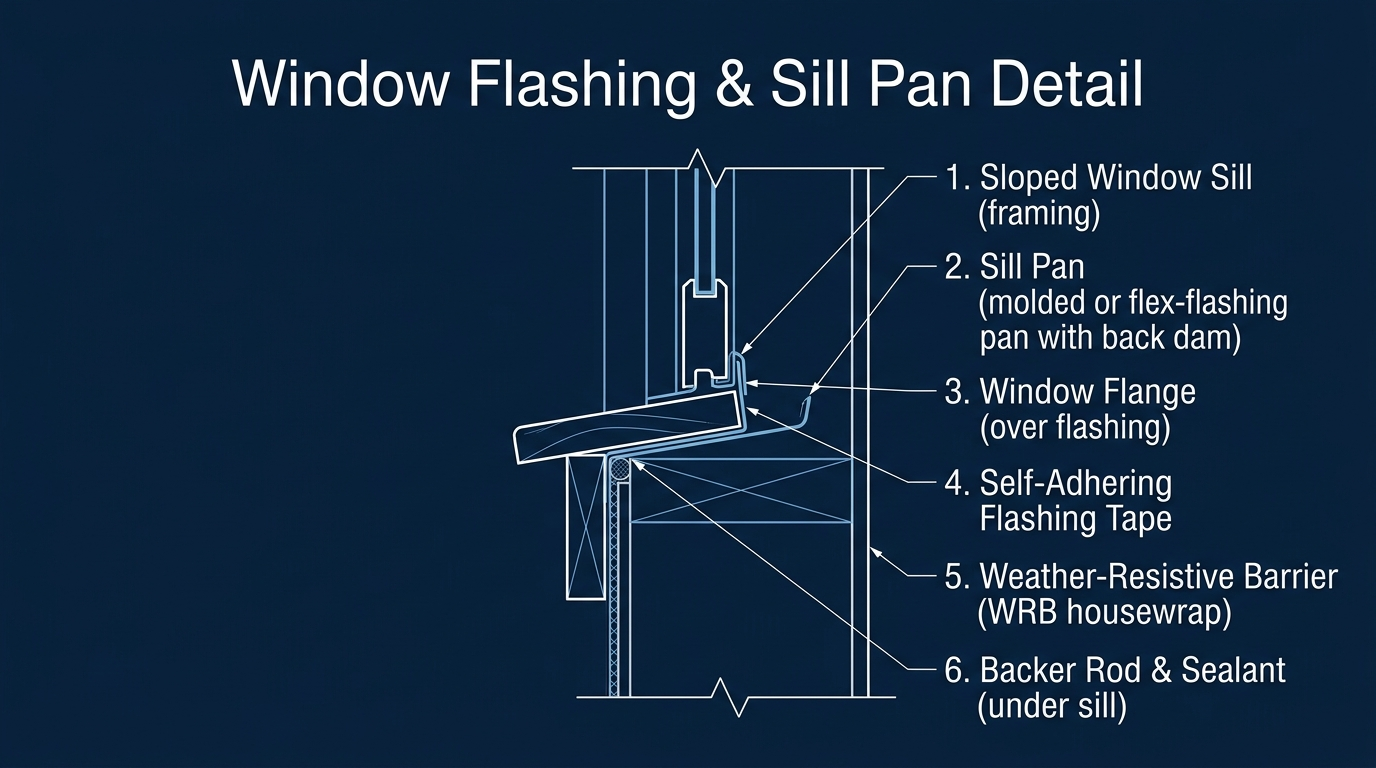
Critical Water Defense: Window Sill Pan Detail
Improper flashing is the leading cause of window water leaks and framing rot. During a full-frame installation, a sloped sill pan with a back dam must be installed to collect any water that bypasses the seals and drain it to the exterior. Refer to the window flashing architectural detail below.
🔌 Share This Diagram on Your Site (Embed Code)▼
Glass Specifications: What the Labels Mean
Any replacement window you purchase should have, at minimum, double-pane insulated glass with Low-E coating and argon gas fill. These aren't premium upgrades: they're the current standard for energy-efficient performance and are required for ENERGY STAR certification in most climate zones (to evaluate your home's total efficiency, see if a home energy audit is worth it).
Low-E coating is a microscopic metallic oxide layer that reflects radiant heat. In cold climates, it reflects interior heat back inside. In hot climates, it reflects solar heat before it enters the glass. The specific Low-E formulation varies by climate zone, solar gain control is more important in the South; heat retention matters more in the North.
Argon fill between the panes reduces conductive heat transfer compared to air. Krypton gas is more effective but significantly more expensive: it's typically specified only for triple-pane units where the narrower gap between panes makes argon less effective.
What Affects the Final Bill Beyond the Window Itself
Several factors push the per-window cost above the baseline range:
Non-standard sizes: Custom-sized openings require custom-manufactured units, which adds lead time and cost.
Difficult access: Second- or third-story windows require extension ladders or scaffolding, adding labor time.
Rot repair: If the installer finds rotted framing or sill, repair adds material and labor before the new window goes in.
RRP compliance: Lead paint procedures in pre-1978 homes add $150–$300 per window in specialized setup and disposal, per EPA requirements.
Get at least three itemized bids that break out material, labor, disposal, and any anticipated prep work separately. A single per-window number from one contractor isn't a meaningful comparison without those details.
Should I do pocket inserts or full-frame replacement?▼
Pocket inserts (also called retrofit inserts) are faster and cost 30–50% less in labor: the new window slides into your existing frame without disturbing interior or exterior trim. They work well when the existing frame is structurally sound and square. Full-frame replacement removes everything down to the rough opening, which lets the installer inspect for rot, reapply flashing, and improve air sealing. If your current frames show any signs of water damage or the opening is out of square, full-frame is the correct approach.
Will new windows reduce my energy bills?▼
ENERGY STAR reports that replacing single-pane windows with qualified double-pane models can reduce heating and cooling costs. The actual savings depend on your climate zone, how drafty the existing windows are, and how much of your home's energy load is attributable to windows versus insulation or HVAC efficiency. ENERGY STAR's savings estimates by region are available at energystar.gov. Expect savings on your total energy bill, not a dramatic transformation of it.
What's the difference between double-pane and triple-pane glass?▼
Double-pane windows are the current building code minimum in most climate zones and adequate for most of the country. Triple-pane adds a third glass layer and second gas-filled cavity, improving insulation in extreme cold. The cost premium for triple-pane is 15–25% over equivalent double-pane units. In climate zones 6–8 (northern Midwest, Northeast, Alaska), the additional insulation value pays back over time. In warmer regions, the payback period is much longer.
§
Research Citations & Verified Authorities
EEAT Compliant
To maintain absolute calculation integrity and trust, the structural lifespans, standard sizes, and pricing models in this guide are gathered from governing construction authorities and verified trade standards.
American Architectural Manufacturers Association (AAMA) - Window Performance StandardsAudit Source →
ENERGY STAR - Residential Windows, Doors, and Skylights SpecificationsAudit Source →
U.S. EPA - Lead Renovation, Repair, and Painting (RRP) RuleAudit Source →
Mauricio L.
// Creator of Meazora
Mauricio L. is a software developer who loves working with his hands. He built Meazora because he was tired of online calculators that exist just to capture your email and phone number. Every calculator here runs completely in your browser to keep your planning private, fast, and simple.